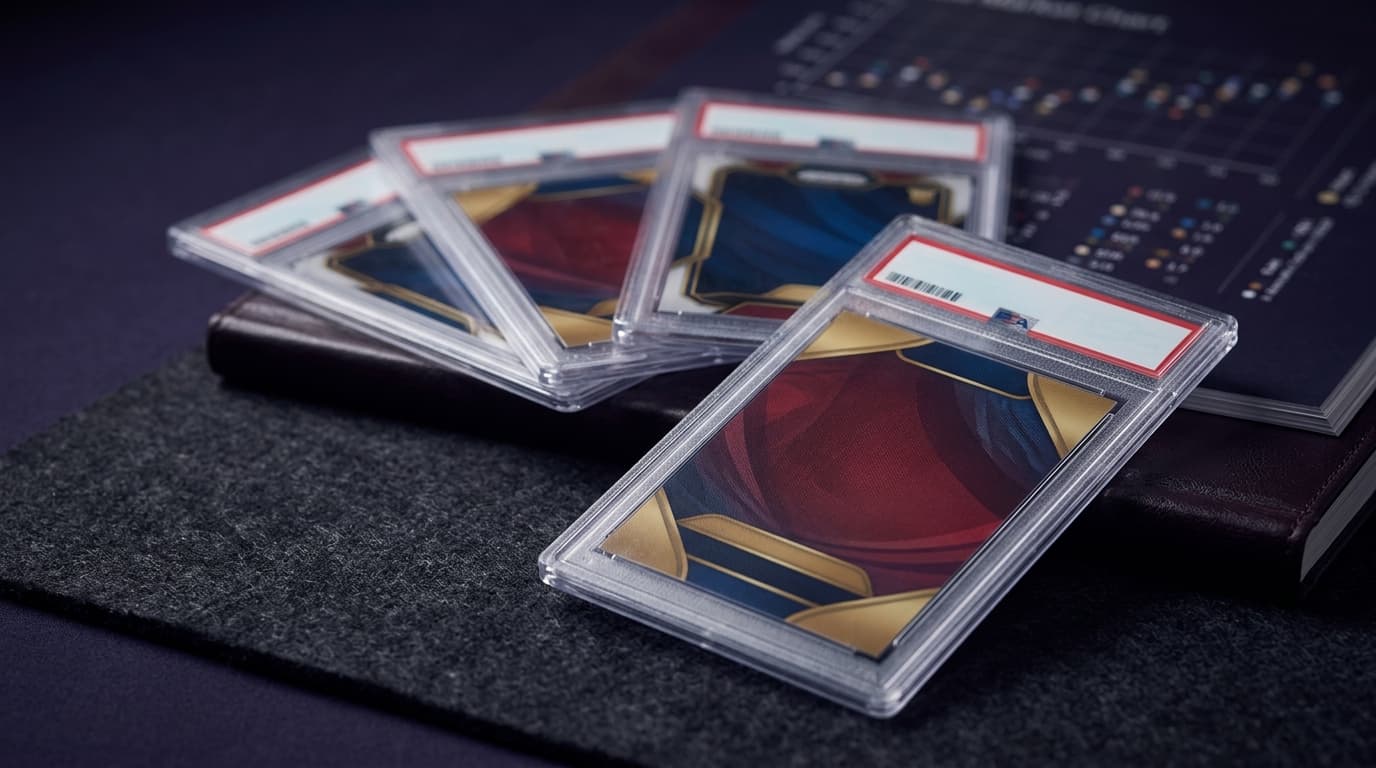
The MSN-style framing — what would happen if PSA shut down tomorrow? — usually gets answered with either hand-waving ("the market would adapt") or doomerism ("the hobby collapses"). Neither is useful. The more honest version of the question is this: in 2025, a single grading company slabbed nearly three of every four cards authenticated worldwide, its parent company quietly bought up two of its three nearest competitors, and the comp data, custody, and marketplace plumbing of a $5B-plus hobby got rewired around that one vendor. That's not a hypothetical. That's the structural position. What breaks if it stumbles is a counterfactual worth taking seriously not because PSA is going away, but because treating its permanence as axiomatic is exactly the assumption that built the concentration in the first place.
How concentrated did this actually get?
The 2025 numbers, compiled by GemRate and reported by Sports Illustrated and cllct, are the cleanest baseline available. The major authenticators graded 26.8 million cards in 2025, a 32% jump year over year. PSA accounted for 19.26 million of those slabs — a 71.8% share. The category mix shifted hard: trading card games and non-sport grew 95% YoY to 16.8 million cards, while sports-card grading volume actually fell 12% to 10.0 million.
The market-share story is bigger than PSA alone. Parent Collectors Holdings acquired SGC in February 2024 and announced a definitive agreement to acquire Beckett in December 2025. Pro forma, the Collectors family — PSA, SGC, and Beckett — accounts for roughly 80% of the grading market. Three of the four legacy names now share one corporate parent. That's the most concentrated grading has ever been.
CGC Cards is the only meaningfully scaled independent left standing. Per Sportico, CGC graded 4.92 million cards in 2025, roughly an 18% share, growing 121% YoY with backing from Fanatics founder Michael Rubin and Blackstone. Everything else — TAG, MBA, smaller regional graders — is a rounding error at industry scale.
The dependency map: it's not just the slabs
If grading were a standalone service, single-vendor risk would be manageable — you'd just resubmit elsewhere. The harder problem is that Collectors owns, or sits at the center of, multiple layers of the stack that downstream pricing depends on:
-
Pop reports. PSA's population data is the denominator under almost every scarcity claim made in the hobby. A PSA 10 Charizard is "rare" because PSA's pop report says so. There is no equivalent cross-vendor registry.
-
Card Ladder and Market Movers. Collectors acquired Card Ladder in 2021. The dominant comp/price-history engines are denominated overwhelmingly in PSA grades; dealer holding prices and insurance valuations chain off those comps.
-
The PSA/Collectors Vault. Per the published PSA Vault Terms, liability is capped at fair market value or replacement cost, with mandatory arbitration. Custody risk now sits inside the same corporate envelope as the grading risk it's supposed to be independent from.
-
Fanatics Collect submission flow. The marketplace launched in July 2024 with PSA as a headline grading partner — though, importantly, it also partnered with CGC, Beckett, SGC, and MBA (see the Fanatics Collect newsroom and Sports Collectors Daily's coverage). The marketplace, at least, is structurally multi-vendor in a way the comp data is not.
-
Dealer inventory pricing. A six-figure dealer holding a PSA 10 vintage card is implicitly long PSA-slab liquidity. The asset is the card, but the price is the slab.
The pieces individually look like routine business consolidation. Stacked, they describe a vertically integrated single point of failure for pricing.
The category-by-category counterfactual
"What breaks" is not uniform. Exposure varies sharply by category. Per GemRate's category breakdown, PSA holds roughly 76% of sports-card grading and 69% of TCG. The downstream consequences:
-
Vintage baseball — catastrophic. Comp infrastructure is denominated almost entirely in PSA. SGC has a respected vintage book but a thin pop report by comparison; CGC has minimal vintage presence. A capacity or trust shock here would freeze price discovery for months.
-
Pre-2020 Pokemon — severe. The category that drove the 95% TCG grading boom is denominated in PSA comps. Regrading at CGC is operationally possible, but the comp history doesn't transfer; the market would re-price under uncertainty.
-
Modern football and basketball — moderate. CGC and Beckett already have meaningful presence. Re-routing volume is plausible, though premiums between grading companies would widen as the market figures out the new equivalencies.
-
Modern TCG — mildest. CGC's surge has already bifurcated this category. Collectors are accustomed to seeing both holders. A shock would sting, but the route-around exists.
SGC's own trajectory under Collectors ownership is instructive: per Sportico's reporting on the GemRate data, SGC volume fell 24% in 2025 after key leadership departures. "Diversifying" into another Collectors-owned grader isn't a hedge — it's the same balance sheet.
Trust shock vs. capacity shock
The hobby just ran a real-world stress test of the trust-shock version. In December 2025, a collector documented 11 modern Pokemon cards that PSA had bought back at PSA 9 prices and then re-listed with the same cert numbers as PSA 10 — the now-infamous grade-swap incident covered by Cardlines and Athlon Sports. The downstream effects were immediate and concrete: Slab-Z reported card-show dealers halting PSA submissions, and the #NoPSAMay boycott in April–May 2026 coincided with softening PSA 10 premiums.
None of that constitutes a shutdown. PSA continued to operate. Volumes continued. But the episode showed that a credibility hit on the dominant vendor produces capacity-shock symptoms — paused submissions, dealer caution, premium compression — without any actual loss of capacity. A real outage would amplify the same dynamics, but with no "come back to PSA next week" relief valve.
Layered on top: a 2026 antitrust class action has been filed alleging monopolistic conduct in the grading market, per Cardlines. The merits will be litigated; what matters for collectors is that the structural concentration is now formally contested in court.
Who'd actually catch the volume?
CGC is the only operational answer. The 121% YoY growth rate documented by Sportico shows it can scale; whether it can absorb something like PSA's 19.26M run-rate in any reasonable window is a different question. SGC and Beckett are inside the Collectors umbrella, so they don't represent independent capacity. TAG and the smaller players don't have the throughput.
The realistic resubmission timeline in a true PSA outage is probably 12–24 months of price discovery — not because the cards change, but because every comp would need to be re-anchored to a different grading scale, and regrade variance between companies would inject real noise into otherwise stable benchmarks. The market wouldn't end; it would just stop knowing what things are worth for a while. For leveraged dealers and consignment auction houses, that interval is the actual risk.
The Fanatics/Collectors tangle
It's worth being precise about the Fanatics relationship, since the shorthand tends to collapse. Fanatics doesn't own PSA. Fanatics Collect, the marketplace, partners with PSA and CGC, Beckett, SGC, and MBA on submissions. Michael Rubin, Fanatics' founder, separately backs CGC alongside Blackstone. So the dominant emerging marketplace is structurally multi-vendor on grading even as the comp and pop-report layer is not. That's a healthier setup than it sounds, but it doesn't unwind the underlying concentration in the data layer where pricing actually lives.
What a sober collector can actually do
Without lurching into doomer territory:
-
Cross-grade your highest-value pieces. Single-vendor exposure on a four- or five-figure card is a choice. CGC, Beckett, and SGC slabs in the highest tier give you optionality you don't have with a PSA-only collection.
-
Favor raw plus multi-grader liquidity on new buys. Especially in modern TCG and modern sports, the market is already bifurcated enough that you're not paying much of a premium for grader-flexible inventory.
-
Treat the PSA/Collectors Vault as concentrated, not diversified. Grading and custody under the same corporate parent, with a liability cap and mandatory arbitration, is a real position — not a neutral storage choice.
-
Watch the leading indicators. The antitrust docket, Fanatics Collect's grader mix, CGC's monthly volume share, and PSA 10 premium spreads over CGC 10 on identical comps are more useful than headlines about any single scandal.
The structural point
The honest answer to "what breaks if PSA disappears" isn't a number. It's a recognition that a $5B-plus market has quietly built itself around a single vendor for grading, a single corporate parent for ~80% of authentication, the same parent for the dominant price-history engine, and an integrated custody product on top of all of it. Whether that vendor is excellent, ethical, and durable in perpetuity isn't really the point. The point is that the assumption it must be is itself the risk. "Too important to fail" is a phrase from a different industry, and it didn't end well there either.
PSA isn't going away tomorrow. But the hobby treating that as an axiom — rather than as a working assumption that needs to be hedged like any other concentrated counterparty risk — is how the concentration got this deep to begin with.
Related reading
Sources
-
cllct — Major Authenticators Graded More Than 26 Million Cards in 2025
-
cllct — Collectors Corners Even More of Grading Market by Acquiring Beckett
-
Sportico — With Fanatics and Blackstone Heft, CGC Cards Aims at PSA
-
Fanatics Collect Newsroom — Fanatics Collect and PSA Partnership
-
Sports Collectors Daily — Fanatics Collect / PSA Submission Program
Note: This article contains AI-assisted content and has been reviewed in our editorial workflow.
DISCLAIMER: PureGrail articles are for informational and entertainment purposes only. Nothing on this site constitutes financial, investment, or legal advice. Collectibles are speculative assets and values can decrease significantly. Always conduct your own research before buying or selling. Past price performance does not indicate future results.