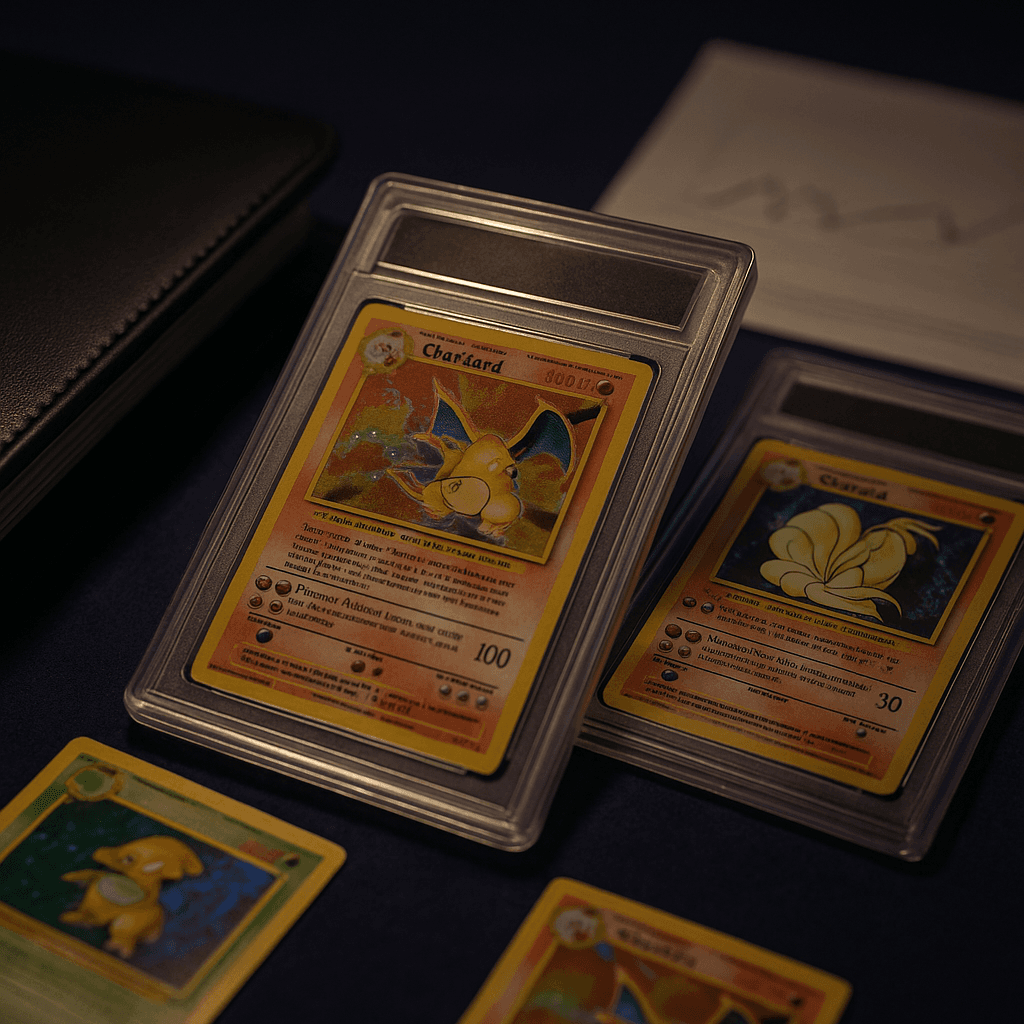
If you collect 1999 Base Set Pokemon, you have heard the rule: Shadowless is worth more than Unlimited. It is true. It is also one of the most consistently mispriced ideas in the hobby. The Shadowless premium is defensible in a surprisingly narrow band - top-grade holographic cards - and a nostalgia tax almost everywhere else. This piece maps where the spread reflects genuine scarcity and where collectors are paying a multiple for what is really a grading-rate bet.
First, untangle the terminology trap
Base Set was printed in a clear order, and the words the hobby uses for those prints do not line up cleanly with what people mean. Per Sports Illustrated's hobby-education breakdown of the Base Set Charizard variants, the sequence runs: 1st Edition (carries the "Edition 1" stamp and has no drop shadow), then Shadowless (no stamp, still no drop shadow), then Unlimited (a drop shadow was added behind the art window) (Sports Illustrated).
Here is the trap. Every 1st Edition card is technically also "shadowless" - it has no drop shadow. But when collectors say Shadowless with a capital S, they mean the unstamped middle print that sits between 1st Edition and Unlimited (Sports Illustrated). The scarcity hierarchy is 1st Edition > Shadowless > Unlimited, with 1st Edition sitting in a different price universe entirely. Conflating "1st Edition Shadowless" with the ordinary Shadowless print is the single most expensive identification mistake a buyer can make - the former is a far rarer animal and trades accordingly. When a comp looks impossibly high, check which print it actually was before you anchor to it.
Verify the print before you pay a Shadowless price
The premium only exists if the card is what the seller says it is. Run this check first, every time. Sports Illustrated's identification guide lists the reliable tells: no drop shadow to the right of and behind the art window; a lighter, less-saturated color palette and a thinner HP font; and a copyright line that reads through '99 (1995, 96, 98, 99) versus Unlimited's string that stops earlier (Sports Illustrated).
Two edge cases matter. Trainer cards have no HP and no art-window shadow at all, so the copyright string is the only way to place them (Sports Illustrated). And a later minor print carrying a "1999-2000 Wizards" copyright sits just above Unlimited and below true Shadowless - a so-called 4th print that is sometimes sold as Shadowless to the inattentive (Sports Illustrated). If you cannot confirm the copyright string and the absent shadow from the photos, treat it as Unlimited until proven otherwise.
Where the premium is real: top-grade holos
Base Set has 16 holographic cards, and that is essentially where the Shadowless premium lives. The chase names - Charizard, Blastoise, Venusaur, Chansey, Mewtwo, Alakazam - carry a genuine scarcity premium at the top of the condition census. But the published "value" numbers most guides still quote are 2020-21 peak-cycle figures, and current comps are materially lower for everything except Charizard.
The peak benchmarks, useful only as historical context: GoCollect's tally of the most expensive 1st Edition Shadowless cards recorded a Blastoise #2 around $45,000 in PSA 10 and roughly $9,000 in PSA 9; Chansey near $37,000 PSA 10 and about $2,000 PSA 9; Venusaur #15 near $22,600 PSA 10 with PSA 9 in the $4,300-$5,000 zone; Mewtwo around $20,000 PSA 10; and Alakazam above $15,000 PSA 10 with PSA 9 near $3,000 (GoCollect). Read those as a high-water mark, not a price sheet. Cardrake's 2026 Base Set guide puts current Shadowless Blastoise at roughly $300 to $3,000+ and Shadowless Venusaur at roughly $200 to $2,000+ depending on condition - a wide band, but one whose ceiling now sits well under the old PSA 9 peak comps that older guides still circulate (Cardrake). Collectors who anchor to 2020-21 numbers are the ones overpaying.
Charizard #4 is the exception that proves the rule: it is the only card where the Shadowless tier holds five-figure money at PSA 10 with conviction, and where 1st Edition sits in six figures. As of early 2026, search-corroborated sold comps place a PSA 10 Shadowless Charizard roughly in the $25,000-$40,000 range against single-digit-thousands for PSA 10 Unlimited - a 4x-10x multiple. But the dedicated price-tracking pages could not be independently archived for this article, so treat those figures as numbers to confirm yourself on the live PriceCharting Shadowless Charizard guide and the PSA CardFacts page before you transact, not as settled fact.
Where the multiple collapses: grade by grade
The single most important pattern in this market: the Shadowless-over-Unlimited multiple is concentrated in the PSA 9-to-10 jump and narrows sharply as you move down the census. You can see it in the GoCollect peak data itself - Blastoise compressing from roughly $45,000 at PSA 10 to about $9,000 at PSA 9, and Chansey from roughly $37,000 to about $2,000 across the same one-grade step (GoCollect). By the time you reach PSA 7-8, the Shadowless print is a markup over Unlimited, not a multiple. Cardrake's own conclusion is consistent with this: on average, Unlimited runs roughly 60-70% cheaper than Shadowless, which is why the guide explicitly recommends a hybrid strategy - buy Shadowless for the chase holos, buy Unlimited for everything else (Cardrake). That recommendation only makes sense because the premium is not worth paying outside the top grades.
The nostalgia tax: Shadowless commons and uncommons
This is where collectors lose money quietly. On commons and uncommons, the raw Shadowless-over-Unlimited spread is small - the eye-popping graded premium is almost entirely gem-rate arbitrage, not card scarcity. Take Shadowless Squirtle #63. PokeInvest's sales data shows a raw copy around $10, a PSA 9 around $121, and a PSA 10 around $770 - roughly 77x the raw price - on a card moving about 455 sales a month (PokeInvest). Almost none of that PSA 10 figure is "Shadowless is rare." It is "a gem-grade copy of a notoriously hard-to-grade print is rare." You are not buying scarcity of the card; you are buying scarcity of the grade. Pay raw-plus-grading-fee money for these, not PSA-9-implied money.
Why raw Shadowless is a submission coin flip
Shadowless Base Set is infamous for off-center cuts, print lines, and holo-foil defects. That matters because PSA's Gem Mint standard demands tight centering - on the order of 60/40 on the front and 75/25 on the back - tolerances you should confirm against PSA's own published standards before submitting. The practical consequence: gem rates on this print are low, and the population is already thin. One secondary estimate puts total PSA-graded Shadowless Charizard near 10,635 copies with only 58 in PSA 10 - about 0.55% (OG Cards). Other third-party counts disagree, so do not trust any single secondary figure; pull the live population straight from the PSA CardFacts report. The qualitative point is firm regardless of which count you believe: PSA 10 is a small minority of an already-scarce print. A raw Shadowless bought at near-PSA-9 money is a bet that you will beat a low gem rate - usually a coin flip, frequently worse.
A practical buy/grade framework
-
Verify the print first. No drop shadow, lighter palette, thinner HP font, copyright string through '99; Trainer cards by copyright string only; watch for the "1999-2000 Wizards" 4th print (Sports Illustrated).
-
Pay the premium only on holos at PSA 9-10. That is the band where the spread reflects real scarcity (GoCollect, Cardrake).
-
Default to Unlimited below PSA 9 and on all commons/uncommons. The hybrid approach exists because the premium does not pay there (Cardrake); the graded common premium is grading arbitrage (PokeInvest).
-
Inspect centering and print lines under angled light before paying graded-adjacent money on a raw copy - gem rates are low.
-
Pull live comps and live pop. Use the PriceCharting sold history and the PSA CardFacts population/APR data. Ignore 2020-21 anchors.
The overpay zone, stated plainly: mid- or low-grade Shadowless, or raw Shadowless, priced at gem-implied multiples; and any value claim anchored to peak-cycle comps. If a seller's price only makes sense against a 2021 number, that is the trade to walk away from.
Closing rule of thumb
Pay the Shadowless premium for top-grade holos you have personally verified. Default to Unlimited for everything else. The market keeps the premium honest exactly where scarcity is real - and quietly overcharges everywhere nostalgia does the pricing.
Related reading
-
The CGC vs PSA Pokémon Premium in 2026: Modern Spread Collapses, Vintage Wall Holds
-
[TCGplayer's May 13 Pokemon Drop List: Oversupply, Mean Reversion, or Early Distribution?](/article/tcgplayer-may-13-2026-pokemon-price-drops-analysis)
Sources
-
Hobby Education: The Many Faces of the Base Set Charizard Card - Sports Illustrated
-
Charizard [Shadowless] #4 Price Guide - PriceCharting (live sold-comp tool)
-
PSA CardFacts - 1999 Pokemon Game Charizard-Holo (Shadowless) #4 (live population/APR reference)
Note: This article contains AI-assisted content and has been reviewed in our editorial workflow.
DISCLAIMER: PureGrail articles are for informational and entertainment purposes only. Nothing on this site constitutes financial, investment, or legal advice. Collectibles are speculative assets and values can decrease significantly. Always conduct your own research before buying or selling. Past price performance does not indicate future results.