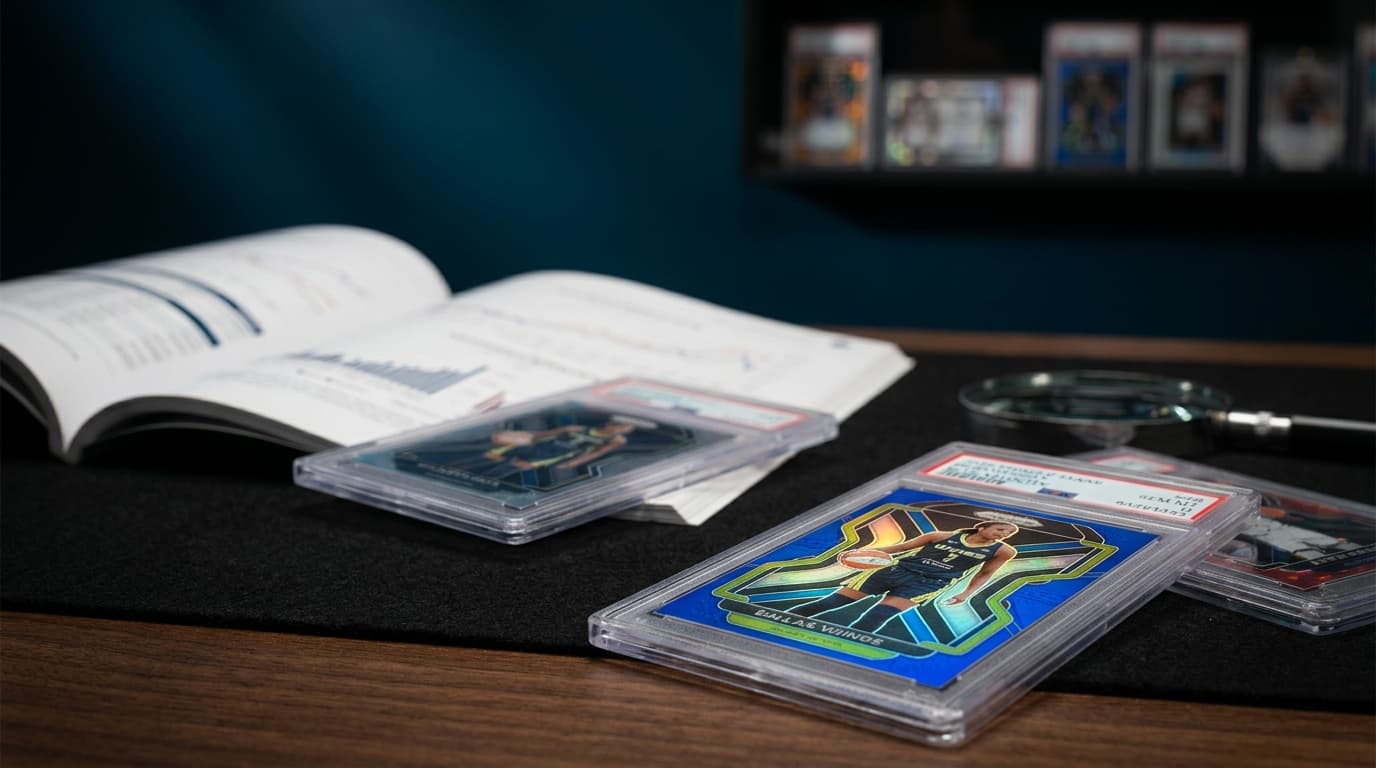
Paige Bueckers' 2025 Panini Prizm base rookie has roughly eight weeks of price history. The product released in April 2026, and as of early June 2026 most of the daily realized-sales counts on her flagship base SKUs are running in the low single digits. That is the most important sentence in any honest write-up of this card right now: when a 'comp' is one to three sales, almost every 14-day trend line you see quoted on social is statistical noise dressed up as a signal.
This piece walks the actual math — base prices, parallel premiums, on-court production, and the Caitlin Clark analogue that already played this exact scene out a year earlier — and tries to be honest about what the data can and cannot tell you yet.
What the 2025 Prizm WNBA set actually is
The 2025 Panini Prizm WNBA Hobby box opened around $749.95 with roughly 24 Prizm parallels and two autos per box, and the parallel ladder runs from base through Silver, Ice, Blue Velocity, the new 2025 color additions (Blue Carolina, Lime Green, Purple Velocity /59) and a thin numbered tier topped by FOTL-exclusive Cherry Blossom /20. Beckett's checklist confirms Bueckers carries two base SKUs — the flagship #5 and the #147 variant — which matters for anyone reading 'base' commentary on social and not noticing the comp set is conflating two cards. Cardlines' breakdown of the parallel print runs is the most useful trade-side reference for understanding where structural scarcity actually lives in this set.
The structural read: most of the 'rarity' marketing in 2025 Prizm WNBA sits in the color and numbered parallels, not the base. That is normal for modern Prizm. What is not normal is that almost every public price discussion of the product collapses base and parallel pricing into a single narrative.
The base rookie: $30–$100 PSA 10, with a thin daily float
Pulling the actual sales aggregators for the two base SKUs — Bueckers #5 and Bueckers #147 — the realized band on PSA 10 base copies has been roughly $30–$100, with raw copies clearing in the $5–$15 range. Sports Card Investor's index across her broader card universe shows the same shape: base trades thin and noisy, parallels carry the premium.
Two structural facts compress this further. First, PSA has already graded more than 11,200 Bueckers cards, against roughly 9,300 for Angel Reese — a float high enough that base PSA 10 pop is unlikely to stay scarce for long. Second, PSA's April 2026 grading-fee changes pushed the base-card submission fee to roughly $25, which is uneconomic against a $5–$15 raw — so new PSA 10 base supply slows mechanically, but the same shift signals that the base tier is no longer where the grading economics work. In other words: pop growth is the headwind, not the tailwind, on the base.
Color premium is doing the work the base no longer does
The cleanest signal in the early secondary market is the ratio. Blue Velocity raws have been clearing around $60 with PSA 10s approaching $300 — a color-to-base premium ratio in the 4–6x range on graded copies. That is consistent with the trade-press read of the set's release window from Athlon Sports, which captured the early secondary-market reception for 2025 Prizm WNBA.
Practically: if you want exposure to the women's-wax bull case, the early data argues the numbered ladder — /59 Velocity colors, Ice, WNBA Logo Prizm, FOTL Cherry Blossom /20 — is where actual scarcity lives. Base is a float-driven product.
The Clark analogue: this scene already played
The most useful comp for a base 2025 Prizm WNBA rookie is the equivalent 2024 Prizm WNBA base from a year earlier. Caitlin Clark's #22 Silver PSA 10 still trades near $3,000 — but the Athlon Sports price-guide data has the Silver raw down roughly -11.4% over the last 30 days, and the Ice raw down -2.1% in the same window. Twelve-plus months past release, the premium-parallel tier held; the base ladder compressed. That is the playbook the Bueckers base is most likely to follow.
The wider Clark picture matters here too. SI Collectibles documents Clark occupying four of the top five WNBA card sales of 2026, and Athlon's macro coverage pegs Whatnot's WNBA search volume up 1,670% in 2025 against roughly 105,000 PSA submissions on Clark cards versus Bueckers' ~11,200 and Reese's ~9,300. The category tailwind is real. It is also disproportionately Clark inventory. That asymmetry is the single biggest unknown when sizing Bueckers' realistic ceiling.
On-court signal: the strongest argument against a deeper drawdown
Where Bueckers diverges from a Reese-style 'pop without efficiency' setup is the production. Through early June 2026, ESPN's game log and StatMuse splits both have her at roughly 18.3 PPG / 3.7 RPG / 5.3 APG on 49.3% FG, 40.9–42.5% from three, and 77.5% from the line — career-best efficiency for the player. Bleacher Report's recap of the June 6, 2026 Wings–Storm game logged a career-high 14 assists, which is the kind of usage-and-role data point that supports a pricing floor on the parallel ladder. Her WNBA.com page confirms the team and rookie-year identifiers underneath all of this.
Production is not a thesis on its own, but in a thin-float segment it is the cleanest argument against a Reese-style decay path. The pricing question is whether the premium tier captures the credit while the base continues to track toward grading cost.
The Dallas Wings discount: theoretical, not yet measurable
Dallas is a bottom-third media market, and the consensus assumption is a market-size discount on Bueckers cards versus an Indiana/Clark baseline. The honest read of the realized data: that discount is not yet visible in PSA 10 prices for premium parallels. It may show up on volume — fewer daily comps, wider bid/ask — without showing up cleanly on price. Anyone underwriting a 'Dallas drag' thesis right now is underwriting an expected effect, not a measured one.
What would actually change the call
-
Five or more daily realized PSA 10 base sales sustained for 30 days — that would convert the current noise into an actual trend you can price.
-
A Dallas playoff path — adds national-broadcast inventory and addresses the market-size question directly.
-
PSA pop crossing roughly 20,000 Bueckers cards graded — that is the level at which base scarcity stops being a serious argument.
-
Caitlin Clark Prizm Silver PSA 10 breaking the ~$3,000 floor — if the dominant comp's premium tier cracks, the entire WNBA Prizm ladder reprices.
Bottom line
On the data available today, the base 2025 Prizm Bueckers rookie looks like a melt-toward-cost story — the Clark playbook, run again — and the parallel ladder is where the women's-wax bull case can actually be priced. The on-court production is the strongest single argument against a deeper base drawdown, but it does not by itself rebuild scarcity in a high-float tier. Daily sales counts of one to three should keep every reader skeptical of confident 14-day trend calls in either direction, including this one.
Related reading
-
Cooper Flagg Card Math, Revisited: Which Duke Bowman Chrome U Premiums Actually Survived Draft Night
Sources
-
2025 Panini Prizm WNBA Basketball Checklist — Checklist Insider
-
Paige Bueckers Basketball Cards Price Guide — Sports Card Investor
-
WNBA Cards Takeover: The Caitlin Clark Effect — Athlon Sports
-
Caitlin Clark Dominates Top 5 WNBA Card Sales of 2026 — SI Collectibles
Note: This article contains AI-assisted content and has been reviewed in our editorial workflow.
DISCLAIMER: PureGrail articles are for informational and entertainment purposes only. Nothing on this site constitutes financial, investment, or legal advice. Collectibles are speculative assets and values can decrease significantly. Always conduct your own research before buying or selling. Past price performance does not indicate future results.