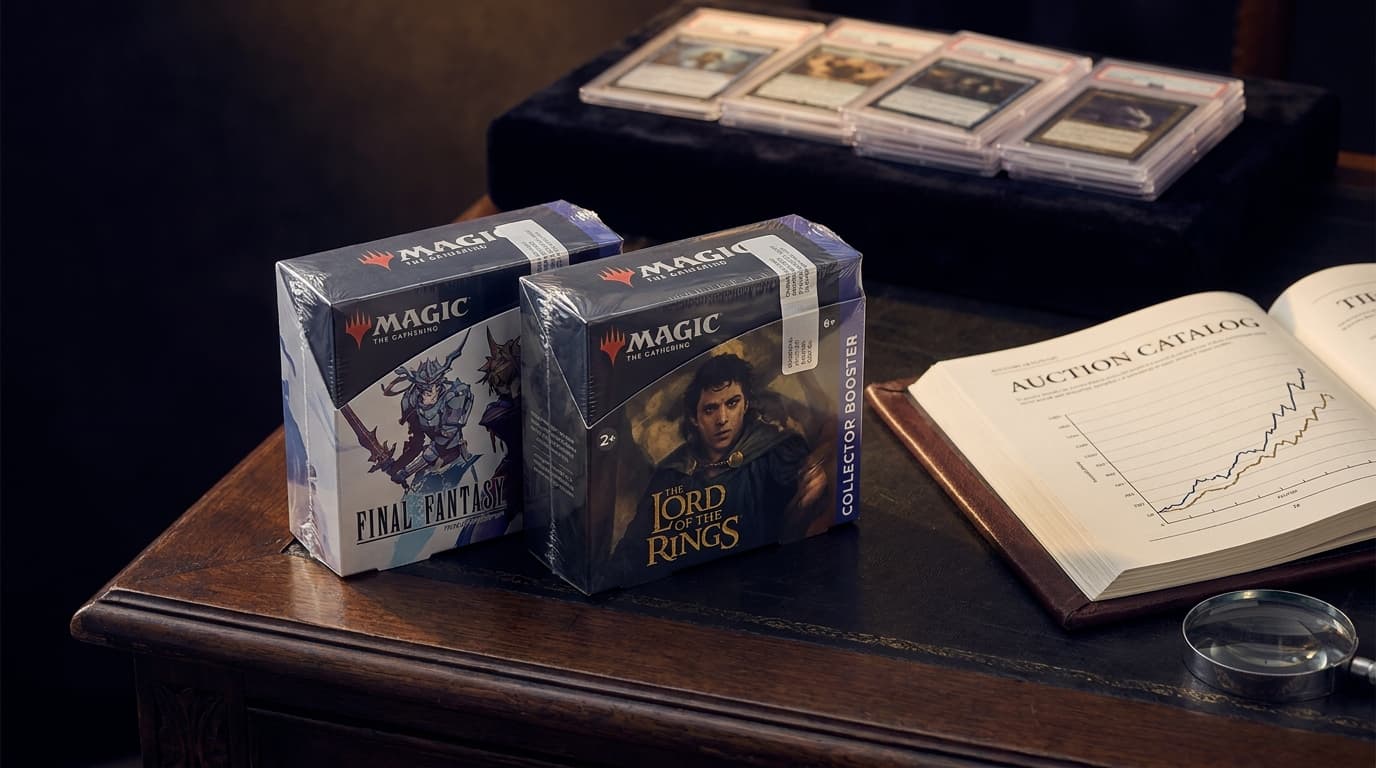
Universes Beyond: Final Fantasy (FIN), released June 13, 2025, is — by Hasbro's own admission — the best-selling Magic: The Gathering set ever produced. It is also the first Universes Beyond tentpole legal in Standard, which separates it cleanly from prior UB releases like Lord of the Rings: Tales of Middle-earth (LTR) that were boxed into Modern and eternal formats. That structural change, combined with a fan base for the source IP that exists almost entirely outside Magic's normal player pool, has produced a sealed-market dislocation worth unpacking carefully before anyone commits capital.
Collector Booster packs carry a $37.99 MSRP per the official Wizards collecting article, putting a 12-pack box at roughly $455 at sticker. That is not where the market cleared. Pre-orders bottomed near a $600 floor in late April 2025, and MTG Rocks documented an $814 average at the June 13 launch with isolated peaks around $1,200. For frame of reference, that is well above where LTR Collector Boxes traded in the same pre-release window — and LTR was, until last week, the most-hyped Universes Beyond release Wizards had shipped.
What's actually inside a Collector Booster box
Before anyone justifies an $800 spend, it is worth being precise about the content rarity inside that box. Per Wizards' own product breakdown, main-set reprints outside basic lands are essentially limited to two cards. The reprint value sits almost entirely in the 64-card Through the Ages bonus sheet, a slate of Constructed staples drawn from across Magic's history and cataloged by EDHREC. The remaining premium content is the Borderless Surge Foil character treatment — the FIN equivalent of LTR's serialized chase slot, though without serialization.
That structure matters because it tells you where price discovery is happening. There are three legitimate demand stacks pressing on the box price, and they should be priced separately.
Tier 1 — Format demand that is actually anchored
A subset of FIN designs has real Constructed and Commander pull. MTG Salvation's analysis flags Vivi Ornitier and Clive, Ifrit's Dominant among a handful of designs with cEDH and broader Commander relevance — meaning the cards will see play even if you strip the Final Fantasy IP off them. Combined with the Through the Ages reprints, this is the part of the box that is priced against utility rather than IP. It is the floor that does not move when the hype fades.
Tier 2 — IP-driven Surge Foil speculation
The top secondary chases are Borderless Surge Foil character cards. ScreenRant's early post-launch pricing places Sephiroth, Fabled SOLDIER near $476; Cloud, Ex-SOLDIER around $395; Tifa, Martial Artist at $315; and Tifa Lockhart at $183. Draftsim's independent ranking matches the same hierarchy. These cards have real buyers — many of whom do not play Magic — but no Standard or Commander demand is anchoring the bid. The price is the IP premium, full stop.
Tier 3 — Halo pricing on non-Surge variants
Non-Surge versions of the marquee FFVII characters are trading well above their mechanical value because of proximity to the Surge chases. This is the most fragile tier. It is the slice that reprices hardest when supply normalizes.
The LTR and Secret Lair comp set
The closest precedents for what happens next are LTR and the IP-themed Secret Lairs. Dot Esports documented that after the 1-of-1 serialized One Ring was pulled, LTR Collector Boxes fell only 6–10% and stabilized. Aetherhub tracks that stabilization around $325–$350, and MTGStocks' multi-month retrospective shows non-serialized The One Ring settled in the $50–60 range.
On the Secret Lair side, The Walking Dead drop ($49.99 MSRP) trades sealed in the $90–$125 band, and the Stranger Things Foil Secret Lair sits around $184. Spellbook Finance's review of which Secret Lairs actually made money identifies a recurring pattern: roughly 30% of IP-themed Secret Lairs follow a climb-flood-recovery arc where the speculative ceiling collapses but an IP-driven floor holds.
The translatable lesson: IP scarcity holds a floor; it does not compound the way speculation expects. Boxes do not collapse, but they do reprice down 6–12 months in once the marquee chase loses novelty and reprints land.
Sealed EV at current prices
Run the numbers honestly. A box at $800 needs to return roughly $800 in expected singles value to justify itself versus targeted singles-buying. The Through the Ages bonus sheet provides a meaningful base, and the Surge Foil character slot is where the upside lives. But EchoMTG's card-level pricing and PriceCharting's sealed time series together show that for a format player, singles-buying beats sealed at current box prices. Sealed only justifies itself if you are an IP collector who values the unopened experience, or a Surge Foil speculator willing to hold 12+ months and accept reprint risk.
The allocation question
A real driver of the current premium is artificial scarcity. MTG Rocks reports retailers received under 20% of their distributor allocation requests, versus the 70%+ fill rate that surprise hits like Tarkir: Dragonstorm saw, and the roughly 100% fill of a normal premier set. Mark Rosewater has publicly committed to reprinting FIN products as promptly as possible — that is the central reset risk for sealed holders. Hasbro CEO Chris Cocks has called Universes Beyond "probably the most successful new player adoption initiative we've ever done," with FIN driving the third-highest backlist quarter on record. WotC has commercial incentive to print into that demand, and Wargamer reports the company is now committing to roughly half of all future sets being Universes Beyond — which structurally pressures FIN's long-term scarcity premium.
Risk matrix
-
Reprint announcement — explicitly signaled. Timing is the unknown, not the event.
-
Standard rotation — FIN's Standard legality is a near-term price support that erodes on a known calendar.
-
FFVII attention curve — Surge Foil character demand correlates with FFVII Rebirth and Remake release-cycle attention.
-
Hasbro guidance — Q-over-Q sales commentary will telegraph print volume decisions before they hit the secondary market.
The PureGrail call
For format players, buy the singles you need. The EV math does not support sealed at $800. For IP collectors, the Borderless Surge Foils of Cloud, Sephiroth, and Tifa are the population-low, iconic-character intersection most likely to hold a non-Magic collector floor — these are the candidates to grade and hold. Non-Surge character cards and the Tier 3 halo pricing are the flip-pre-reprint slice; the asymmetry there is bad. Sealed Collector Boxes at $800+ are the position to walk away from unless you have a specific Surge speculation thesis and a 12-month horizon. The LTR comp tells you a 6–10% post-chase decline is the optimistic case; the Secret Lair comps tell you reset, not collapse, but reset is enough to make today's entry price unattractive.
FIN is a genuinely successful product. That is not the same as a good sealed buy at $800.
Related reading
Sources
-
Collecting Magic: The Gathering — FINAL FANTASY (Wizards of the Coast)
-
Unprecedented Demand Causes Final Fantasy Booster Box to Hit $1,200 — MTG Rocks
-
MTG Designer Reassures Players Following Final Fantasy Supply Issues — MTG Rocks
-
Universes Beyond: FINAL FANTASY — All Cards and Prices — EchoMTG
-
The 19 Most Expensive and Must-Have Cards in Final Fantasy — Draftsim
-
Final Fantasy Is Secretly One Of The Best Sets For Commander In Years — MTG Salvation
-
MTG product prices remain high after The One Ring serialized LTR card pulled — Dot Esports
-
What Happens To LOTR Collector Box Price With The One Ring Found — Aetherhub
-
Checking In With Lord of the Rings: Tales of Middle-earth — MTGStocks
-
MTG lead designer confirms HALF of all future sets will be Universes Beyond — Wargamer
Note: This article contains AI-assisted content and has been reviewed in our editorial workflow.
DISCLAIMER: PureGrail articles are for informational and entertainment purposes only. Nothing on this site constitutes financial, investment, or legal advice. Collectibles are speculative assets and values can decrease significantly. Always conduct your own research before buying or selling. Past price performance does not indicate future results.