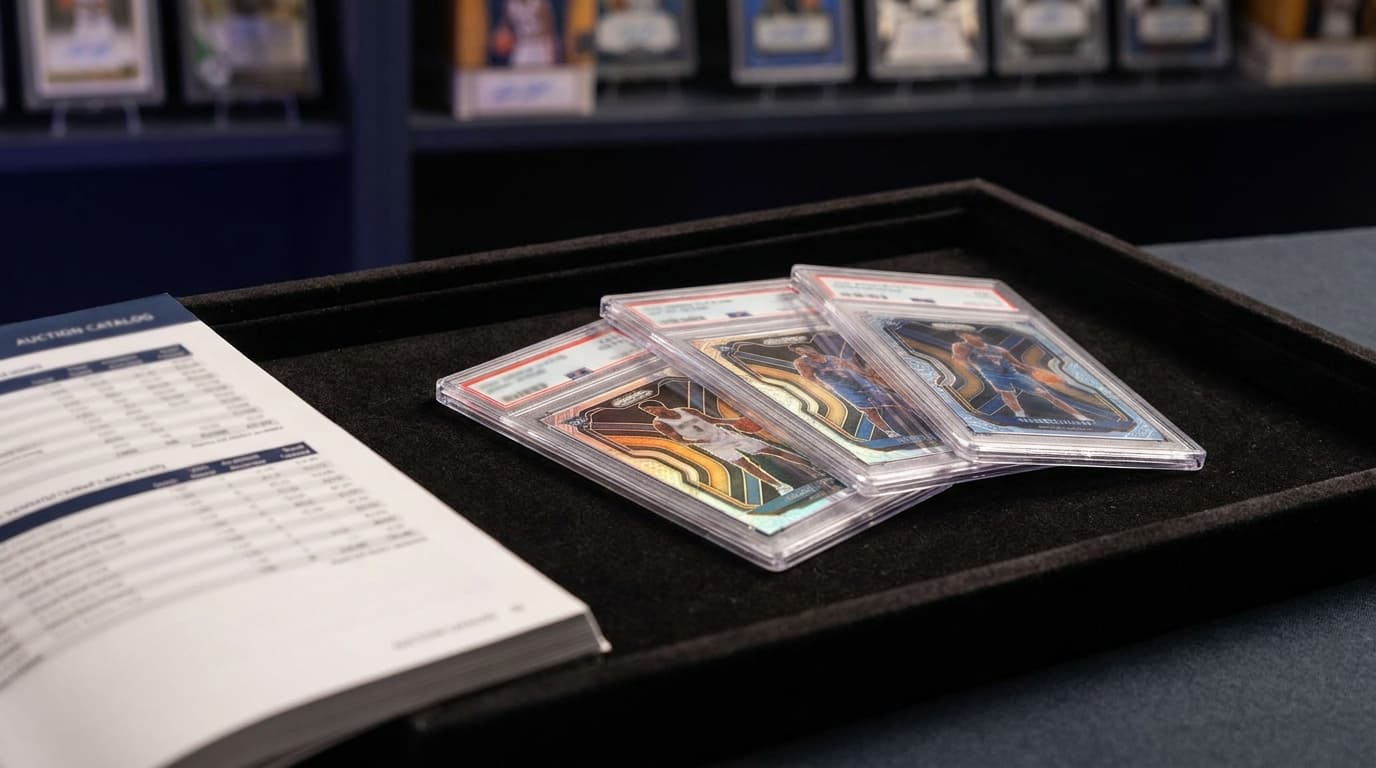
If you read the hobby chatter heading into the final week of May, you saw a tidy and slightly alarming headline: four premium basketball products dropping in a single week. It makes for a good panic. It is also not quite true, and the correction matters for how you should think about your launch-week budget.
The real glut: three premium products in 72 hours
Here is what is actually hitting on-sale dates in the late-May window:
-
Panini Signature Series Basketball - May 27, 2026 (date listed as subject to change).
-
Topps Signature Class Basketball - May 28, 2026.
-
Bowman Sapphire Basketball - May 29, 2026.
That is three premium, autograph-led releases inside a 72-hour span. It is a genuine glut, and it is enough to fragment attention and wallets on its own.
The fourth name people keep adding to the list is Topps Motif Basketball. Motif was previewed and catalogued by Beckett during this same late-May window, which is almost certainly where the 'four in one week' framing came from. But per Topps' own release calendar, Motif is a pre-order June 9 / on-sale June 10, 2026 product (Checklist Insider still lists its release as TBA). Catalog activity is not an on-sale date. If you are budgeting against four launches this week, you are budgeting against a calendar that does not exist.
Why calendar density actually matters
The problem with three premium products in three days is not the number of boxes on shelves. It is that they are all chasing the same names. Every one of these checklists is built around the headline 2025 rookie class - Cooper Flagg, Ace Bailey, AJ Dybantsa, Kon Knueppel - plus the same legends and stars, including LeBron James, Victor Wembanyama, and Shai Gilgeous-Alexander.
When three checklists fight over the same chase cards and the same buyers within days, demand gets divided and launch-week attention gets split. That is the dynamic worth watching, not the SKU count by itself.
The licensing fault line
This is the part the 'count the boxes' framing misses entirely, and it is the single most important analytical hook for which configurations hold value.
Panini lost the NBA license to Fanatics, with the change effective in late 2025. As a result, 2025-26 Panini basketball is unlicensed: it carries NBPA player rights only, with no NBA team logos or marks. Coverage of the license loss notes that unlicensed product cannot use team logos or official uniforms, and that historically this has weighed on perceived and secondary-market value.
By contrast, Topps Signature Class, Bowman Sapphire, and Topps Motif all carry full Fanatics-era NBA licensing. So when you line these products up side by side, you are not comparing four equivalent boxes. You are comparing licensed product against one unlicensed entrant, and that distinction has historically mattered more to resale than any single product feature.
Configurations and price anchors, side by side
Strip away the branding and look at what buyers are actually paying per hit:
-
Topps Signature Class (NBA-licensed): an autograph-focused 'Signature Class' NBA debut with a 150-card base set including 50 rookies. Hobby delivers 2 autos across 8 packs of 4 cards at $539.99; Jumbo delivers 4 autos at $899.99. Retail runs to a $64.99 Mega and a $34.99 Value Blaster. Teased signers include Cooper Flagg, Ace Bailey, SGA, Wembanyama, and LeBron.
-
Panini Signature Series (unlicensed): a debut premium brand built around one encased/slabbed autograph per hobby box. A typical hobby box yields roughly one slabbed auto, two base parallels, one insert, and one base card, with a hobby presell around $249.95 and a 12-box hobby case (per DA Card World).
-
Bowman Sapphire (NBA-licensed): a slimmed-down premium version of flagship Bowman that combines NBA pros with NCAA/college prospects, 4 cards per pack across 8 packs per hobby box, carrying the Sapphire-exclusive 'Treasured Talents' insert - the first time pro athletes appear on it. Pricing is governed by its online-exclusive model rather than a standard distributor MSRP.
-
Topps Motif (NBA-licensed, June release): 5 autos per hobby box across 8 cards, in Hobby and FDI formats. The prior edition retailed at $499.99, and unlike the unlicensed 2023-24 debut, this edition carries the full NBA license.
The takeaway is not that one box is 'better.' It is that the autograph-per-dollar math, the license, and the product role are different enough that treating them as interchangeable launch-week purchases is a mistake.
Allocation is the real price lever
If you want to predict which of these resists launch-week softening, look at how each one is distributed, not how many SKUs exist:
-
Bowman Sapphire is an online-exclusive at Topps.com - controlled print, no open shelf flood.
-
Topps Signature Class hobby was allocated via an EQL raffle, with presales that opened April 28 - a gate on who gets boxes at MSRP.
-
Panini Signature Series is widely available through open distributor presell - the least restricted of the three.
Historically, controlled-allocation and online-exclusive product has held launch-week pricing better than wide-release, high-print product. Allocation, more than the number of competing releases, is the variable that tends to separate the boxes that hold from the boxes that sag.
How saturation pressures launch-week prices - and what we can and cannot say
A clear caveat before any pricing talk: these products release May 27-29, 2026. As of this writing there is no verifiable post-launch box-price or secondary-market data for any of them. So treat what follows as forward-looking analysis grounded in supply dynamics, not as observed results - and be skeptical of anyone quoting specific 'price drop' percentages this early, because that data does not yet exist.
The mechanism is simple. Launch-week dollars are finite. When overlapping supply chasing the same chase cards lands within days, those dollars get spread thin. In that environment, the product most exposed to softening is typically the one that is widely available, high-print, and - in this slate - unlicensed, because it has the weakest structural support on both the supply side and the resale side. Controlled-print and licensed product has more historically resisted that pressure. That is an expectation based on how saturated slates have behaved before, not a measured outcome for these specific boxes.
A practical sequencing guide
If you are buying into this window, the trap is treating every drop as a must-hit. A more disciplined order of operations:
-
Prioritize licensed and allocated product if your goal is value retention. Online-exclusive (Bowman Sapphire) and raffle-allocated (Signature Class) product has the structural traits that have historically resisted launch-week softening.
-
Be deliberate on the unlicensed entrant. Panini Signature Series may be the easiest to buy at launch precisely because it is the most widely distributed - which is also why it carries the most launch-week price risk. Buy it because you want the product, not because it is available.
-
You do not have to win every checklist. These sets overlap heavily on the same rookies and stars. Chasing all of them within one week means paying launch premiums across redundant chase lists. Picking one or two and waiting out the rest is a defensible plan, not a missed opportunity.
-
Motif is not a this-week decision. It is a June product. Do not let preview coverage pull June dollars into May.
Bottom line
The honest version of the story is less dramatic and more useful than 'four releases in one week.' It is three premium products in 72 hours, one of them unlicensed, distributed through very different allocation models, all fighting over the same rookie class. The buyers who come out of this window without overpaying will be the ones who let licensing and allocation - not the release-count headline - decide where their launch-week money goes, and who stay patient enough to wait for actual post-launch pricing before declaring any box a winner or a loser.
Related reading
Sources
-
2025-26 Topps Signature Class Basketball Checklist, Team Set Lists and Details (Beckett)
-
2025-26 Bowman Sapphire Basketball Checklist Details, Box Info (Beckett)
-
2025-26 Panini Signature Series Basketball Checklist, Team Set Lists and Details (Beckett)
-
2025/26 Panini Signature Series Basketball Hobby Box (DA Card World)
-
2025-26 Topps Signature Class Basketball Hobby Box Pre-Order (Topps Launches/EQL)
-
2025-26 Topps Motif Basketball Checklist Details, Autographs (Beckett)
-
Panini Loses NBA & NFL Licensing: What It Means for Collectors (Pristine Auction Blog)
-
2025-26 Basketball Card Release Dates, Checklists and Set Information (Beckett)
-
2025-26 Topps Motif Basketball Checklist, Set Info, Odds, Boxes (Checklist Insider)
Note: This article contains AI-assisted content and has been reviewed in our editorial workflow.
DISCLAIMER: PureGrail articles are for informational and entertainment purposes only. Nothing on this site constitutes financial, investment, or legal advice. Collectibles are speculative assets and values can decrease significantly. Always conduct your own research before buying or selling. Past price performance does not indicate future results.